Radha Naam Jap is a simple devotional practice centered on remembering and chanting the name of Shri Radha. For many devotees, chanting is not about rushing through a fixed number of repetitions. It is about slowing down, listening to the name, and bringing the mind back to devotion.
If you are completely new to Radha Naam Jap, you do not need an elaborate setup. You can begin with a few minutes each day, chant softly or aloud, and gradually develop a regular practice.
This guide explains what Radha Naam Jap is, how to begin, how to use a japa mala, how many times to chant, and how to stay focused.
What Is Radha Naam Jap?
“Naam Jap” means the repeated remembrance and chanting of a divine name.
In bhakti traditions, chanting the names of God is an important devotional practice. Individual chanting is commonly known as japa, while devotional chanting with others may take the form of kirtan. ISKCON describes japa as individual mantra meditation and kirtan as congregational devotional chanting.
Radha Naam Jap specifically focuses on remembering and chanting the name of Shri Radha with devotion.
The practice can be very simple:
Radhe, Radhe.
You may repeat the name slowly, allowing each repetition to be heard clearly.
There is no need to make the practice complicated when you are starting.
Why Do People Chant Radha Naam?
For a devotee, chanting is primarily a form of remembrance and devotion.
The name “Radha” is deeply connected with the devotional traditions of Vrindavan and the worship of Radha and Krishna. Different Vaishnava traditions have their own practices, explanations and forms of chanting, so there is no single universal method that every devotee must follow.
The important starting point is sincerity.
Rather than thinking only about completing a number, try to give your attention to the name as you chant.
A useful principle in japa practice is attentive hearing. Traditional japa instructions emphasize clearly chanting and listening to the holy names rather than mechanically trying to finish a fixed number as quickly as possible.
How to Chant Radha Naam
If you are a beginner, start with these simple steps.
1. Choose a quiet place
Find a place where you can sit comfortably without frequent interruptions.
It could be:
- A small prayer space at home
- A quiet corner of your room
- A temple
- A peaceful outdoor location
- Any clean and comfortable place where you can concentrate
You don’t need a special room.
Consistency is more important than creating a perfect environment.
2. Sit comfortably
Sit in a position that allows you to remain comfortable for several minutes.
You can sit on the floor, on a cushion, or on a chair.
There is no need to force your body into an uncomfortable posture.
The purpose is to make it easier to give your attention to chanting.
3. Take a moment to settle your mind
Before beginning, pause for a few seconds.
Put aside your phone and other distractions if possible.
You can silently offer a simple prayer such as:
“May I chant with sincerity and attention.”
Then begin.
4. Chant the name slowly
Start repeating:
Radhe, Radhe
or another form of Radha Naam that is part of your devotional tradition.
You can chant:
- Softly
- Aloud
- In a whisper
- Mentally
If you are using a particular mantra or devotional practice taught by your guru or tradition, follow that instruction.
The most important thing for a beginner is to actually listen to what you are chanting.
5. Hear each repetition
This is one of the most useful habits you can develop.
Instead of allowing the mind to race ahead, listen to the sound of each repetition.
For example:
Radhe… Radhe…
Then repeat.
When your attention moves to work, family, plans, notifications or other thoughts, gently bring it back.
You don’t need to become frustrated when the mind wanders.
Simply return to the name.
Should You Use a Japa Mala?
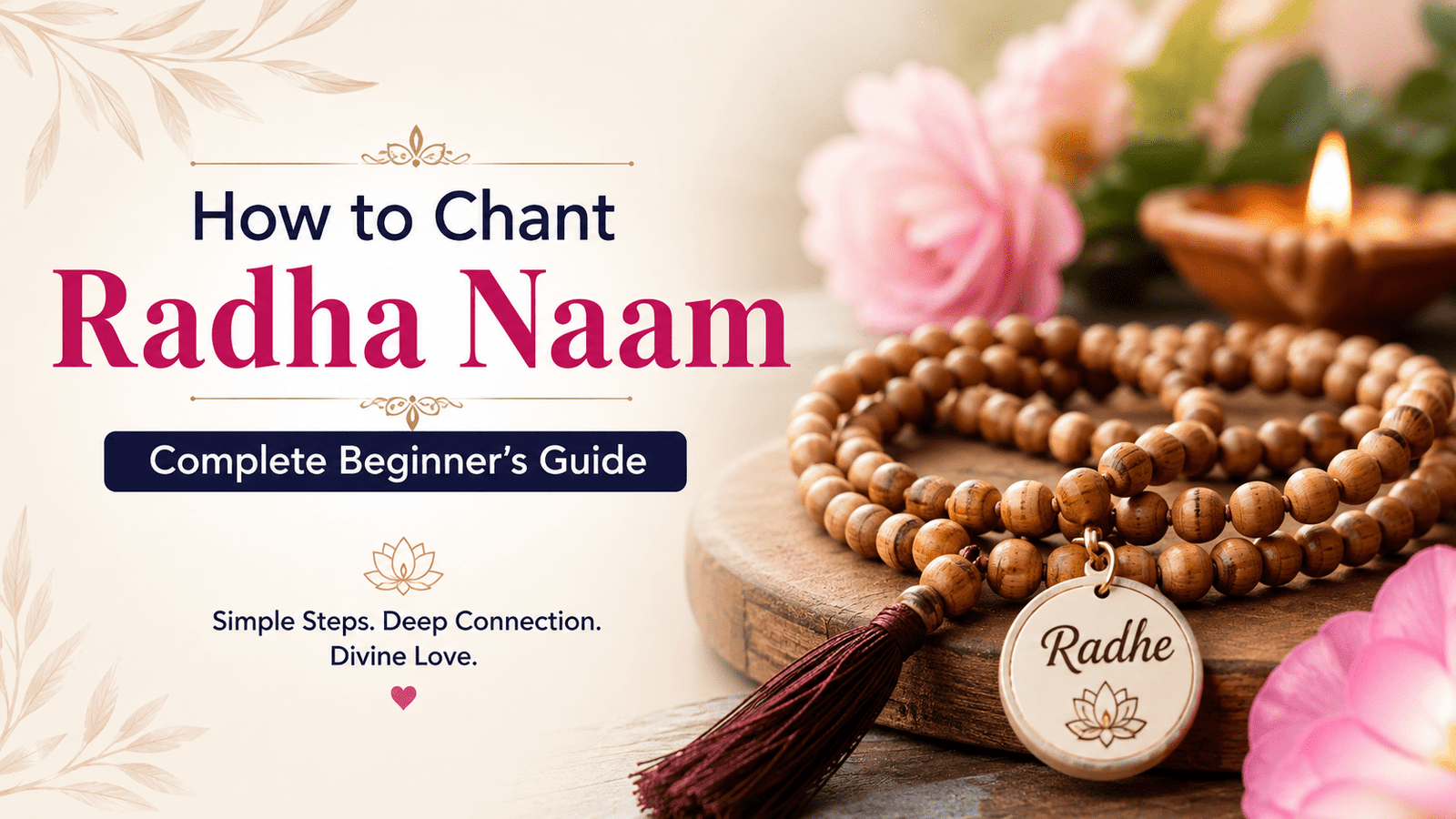
A japa mala can make counting easier and give your hands something tangible to focus on.
In Vaishnava japa practice, a traditional mala commonly has 108 beads plus a larger head bead. Practitioners move from bead to bead while chanting, using the beads to keep track of repetitions.
For a beginner, however, a mala is not the only option.
You can begin with:
- Your fingers
- A simple digital counter
- An online japa counter
- A traditional japa mala
The goal is not to buy something before you begin.
Start with the method that helps you chant consistently.
How to Chant Radha Naam With a Japa Mala
If you decide to use a mala, the basic process is straightforward.
Step 1: Hold the mala comfortably
Traditions can differ in how beads are held and used, so if you follow a particular lineage, follow its instructions.
In the Vaishnava japa method described by Krishna.com, practitioners use the thumb and middle finger to move the beads while chanting. The index finger is kept separate from the beads.
Step 2: Start with one bead
Choose the starting bead according to the instructions of your tradition.
Chant your chosen name or mantra once.
Step 3: Move to the next bead
After completing one repetition, move to the next bead.
Continue the same process.
Step 4: Continue around the mala
A traditional 108-bead japa mala allows you to count your repetitions without repeatedly checking a clock or screen.
One complete circuit of the 108 beads is commonly referred to as one round of japa.
How Many Times Should You Chant Radha Naam?
There is no single number that every beginner must follow.
You can begin with:
11 repetitions
or:
27 repetitions
or:
54 repetitions
or:
108 repetitions
The right starting point is one that you can maintain regularly.
If you have been given a specific chanting practice by a spiritual teacher or tradition, follow that guidance rather than replacing it with a generic internet recommendation.
Why Is 108 Common?
The number 108 has a long-standing place in Indian spiritual traditions, and 108-bead malas are widely used for japa.
Different Vaishnava explanations are given for the significance of 108, and some aspects of the practice are preserved through traditional lineages rather than being based on one universally accepted explanation.
For a beginner, the practical point is simple:
108 beads make it easy to keep track of one complete round of chanting.
Radha Naam Jap for Beginners: A 5-Minute Routine
You don’t need to start with a long session.
Try this simple routine.
Minute 1: Prepare
Sit comfortably and put distractions aside.
Take a few natural breaths and settle down.
Minutes 2–4: Chant
Begin repeating:
Radhe, Radhe
Chant slowly enough that you can hear each repetition.
If your mind wanders, return your attention to the name.
Minute 5: Finish peacefully
Don’t immediately jump to your phone or another task.
Sit quietly for a few moments and allow the practice to end naturally.
Once this becomes comfortable, you can gradually increase the duration.
Should You Chant in the Morning or Evening?
Choose a time you can maintain.
Many practitioners prefer early morning because the surroundings can be quieter and there may be fewer distractions. Traditional japa guidance also emphasizes establishing a regular time and creating conditions that support concentration.
But a beginner should not wait for the “perfect” time.
If morning is difficult, try:
- After your morning routine
- During a quiet afternoon
- After work
- Before bedtime
- Any consistent time that fits your daily life
A short daily practice is often easier to maintain than an ambitious routine that quickly becomes difficult to follow.
What Should You Think About While Chanting?
You don’t have to force your mind to imagine anything.
Start by listening.
If thoughts appear, notice them and return to the name.
You can also contemplate Radha’s devotional qualities, remember Vrindavan, look at a sacred image, or simply focus on the sound of the name.
Different devotional traditions encourage different forms of meditation and remembrance.
The simplest practice for a beginner is:
Chant → Hear → Notice distraction → Return to chanting.
What If My Mind Keeps Wandering?
This is normal.
A wandering mind does not mean that you are failing.
Japa itself can become a practice of repeatedly bringing attention back to the holy name. Traditional discussions of japa emphasize concentration, attentive hearing and patience.
Try these simple adjustments:
Reduce distractions
Keep your phone away or switch it to silent mode.
Slow down
If you are rushing, deliberately slow your chanting.
Listen carefully
Pay attention to the sound instead of thinking about how many repetitions remain.
Choose a regular time
A consistent routine can make chanting easier.
Start small
Five focused minutes can be a better starting point than an unrealistic one-hour goal.
Can You Chant Radha Naam Without a Mala?
Yes, you can choose a method that works for your practice.
A mala is useful for counting and is an established part of many japa traditions, but someone beginning a devotional practice can start by chanting without beads.
You can count using:
- Fingers
- A small counter
- A digital japa counter
- An online counter
- A traditional mala
The advantage of a counter is that you can concentrate on chanting without trying to remember the number of repetitions.
Radha Naam Counter: A Simple Way to Track Your Chanting
If you want to focus on chanting without manually counting every repetition, a digital counter can be useful.
The Radha Naam Counter lets you keep track of your chanting digitally.
You can use it for a short daily practice or for a specific repetition goal such as 108.
The important point is to treat the counter as a tool for your practice, not as the practice itself.
The number tells you how many repetitions you completed.
Your attention and devotion give those repetitions their personal meaning.
108 Radha Naam: A Simple Practice
If you want to begin with 108 repetitions, keep it simple.
- Sit comfortably.
- Put distractions aside.
- Set your intention.
- Begin chanting Radha Naam.
- Count each repetition using a mala or counter.
- Listen carefully to each repetition.
- When the mind wanders, return gently to the name.
- Complete your chosen number.
- Sit quietly for a few moments afterward.
Don’t worry about speed.
The objective is not to finish 108 repetitions as quickly as possible.
Common Mistakes Beginners Make
Trying to chant too much immediately
Starting with an extremely large number can make the practice feel like a task.
Start with something sustainable.
Focusing only on the number
Counting is useful, but don’t allow the counter to become more important than the chanting.
Expecting an immediate spiritual experience
Not every session will feel the same.
Some days may feel peaceful. Other days may feel distracted or ordinary.
Regularity matters more than trying to recreate a particular feeling.
Getting frustrated by thoughts
The mind will wander.
Return to the name without becoming discouraged.
Copying another person’s practice exactly
Different devotional traditions and teachers may recommend different practices.
Learn from a trusted tradition if you want a more formal practice.
A Simple 7-Day Beginner Plan
If you have never practiced Radha Naam Jap before, try this:
| Day | Practice |
|---|---|
| Day 1 | 5 minutes |
| Day 2 | 5 minutes |
| Day 3 | 11 repetitions |
| Day 4 | 27 repetitions |
| Day 5 | 27 repetitions |
| Day 6 | 54 repetitions |
| Day 7 | 108 repetitions |
This is only a suggested beginner routine, not a religious requirement.
If 108 repetitions feel too much, stay with 11 or 27 and build gradually.
If you already have an established spiritual practice, continue following the guidance of your teacher or tradition.
Radha Naam Jap and Japa Mala: Which Should You Choose?
You don’t necessarily have to choose one over the other.
A japa mala can help you count and establish a traditional physical practice.
A digital counter can be convenient when you are travelling or don’t have your mala with you.
You may also simply chant without counting when your intention is devotional remembrance rather than completing a particular number.
Choose the method that helps you remain sincere, attentive and consistent.
Frequently Asked Questions
What is Radha Naam Jap?
Radha Naam Jap is the devotional repetition and remembrance of the name of Shri Radha. It can be practiced softly, aloud or mentally, depending on the practitioner’s tradition and circumstances.
How many times should I chant Radha Naam?
There is no universal beginner number. You can start with a small, manageable number such as 11 or 27 repetitions and gradually increase to 108 if that suits your practice.
Can I chant Radha Naam without a mala?
Yes. You can chant without beads or use your fingers, a digital counter or an online counter to keep track of repetitions.
Why are there 108 beads on a japa mala?
108 is a traditional number associated with japa malas. Vaishnava sources provide several traditional explanations for its significance, and the practice is also transmitted through devotional lineages.
Is it better to chant in the morning?
Morning can be convenient because it may offer a quieter environment, but the best time for a beginner is a time that can be practiced consistently.
What should I do when my mind wanders?
Don’t become discouraged. Gently bring your attention back to the sound of the name and continue.
Can I use a digital counter instead of a mala?
Yes, if your purpose is simply to keep track of repetitions. A traditional mala remains important within traditions that prescribe or prefer it, while a digital counter can be a convenient counting tool.
In Summary
Radha Naam Jap does not need to begin with a complicated routine.
Find a quiet place. Sit comfortably. Put distractions aside. Chant sincerely and listen carefully to the name.
Start with a few minutes if that is all you can manage.
Over time, you may find that a simple daily practice becomes a meaningful part of your spiritual routine.
The goal is not to compete with anyone else’s number of repetitions.
Begin where you are, chant with attention, and allow the practice to grow naturally.
Radhe Radhe.
Further Reading
Sources and Traditional References
This guide draws on established explanations of japa and devotional chanting from Krishna.com and ISKCON, including guidance on japa beads, attentive chanting, 108-bead malas and bhakti-yoga practice.